Mirror-image detection (chirality K + mirror RMSD)
A Cα structure-based (Gō) model can fold a chain into the global mirror image
of its native structure. This is a well-known artifact of one-bead-per-residue
models: with only Cα beads and distance-based contacts, the potential is (very
nearly) blind to handedness, so the enantiomeric fold sits in an almost
equally deep energy basin. TOPO ships
topo.analysis.mirror, a post-processing analysis that flags mirror frames
frame-by-frame and returns a per-trajectory verdict.
Important
Why this matters for CG simulations: do not overestimate misfolding. A mirror image preserves almost all native contacts, so the Q score (Native-contact analysis (the Q score)) reads it as folded (\(Q \to 1\)). Judged on Q alone the run looks native. But if you inspect the structure by eye — or compute an ordinary RMSD that allows reflection during alignment — the mirror can look badly misfolded, and you may discard a run that actually folded correctly in every way except handedness, or conversely accept a mirror as native. Either way the misfolded fraction of an ensemble is estimated wrong. Q cannot tell the two apart; the metrics here can, and are meant to be reported alongside Q, not instead of it.
The physical picture
Fold handedness is a global chirality: proteins are built from L-amino acids, so native folds have a definite handedness (right-handed α-helices, a specific twist of β-sheets, a specific sign to the way secondary-structure elements pack). Reflect every coordinate through a plane and you get a structure with identical bond lengths, identical contact distances, identical radius of gyration — but the opposite handedness. It is a different, non-superimposable molecule (you cannot rotate a left hand onto a right hand), yet every distance-based observable is unchanged.
That is exactly why a Cα Gō model is prone to it. The forcefield rewards native distances; it has essentially no term that rewards native handedness. The mirror fold satisfies the distance restraints just as well as the native fold, so during folding the chain can commit to the wrong enantiomer and stay there. The two analyses below supply the missing handedness information.
Both are Cα-only, reference-based metrics, in the same spirit as the Q
scorer: each frame is compared against the native reference read from the
all-atom pdb_file.
Metric 1 — mirror-sensitive RMSD
Physical meaning. Fit each frame onto (a) the native reference and (b) an explicitly reflected copy of the native, and ask which it resembles more. A native-like fold is closer to the native; a mirror fold is closer to the reflected native.
Technical meaning — why an ordinary RMSD is not enough. RMSD is computed after an optimal superposition. If that superposition is allowed an improper transformation (a rotation with a reflection, determinant \(-1\)), it will happily reflect a mirror structure onto the native and report a deceptively small RMSD — the reflection is silently absorbed by the fit and the mirror becomes invisible. Mirror detection therefore requires two things:
A proper-rotation-only Kabsch fit (determinant fixed to \(+1\)). Given centered frame \(X\) and target \(T\),
\[\begin{split}H = X^\top T,\quad U\Sigma V^\top = \mathrm{SVD}(H),\quad d = \operatorname{sign}\!\big(\det(UV^\top)\big),\\ R = U\,\operatorname{diag}(1,1,d)\,V^\top,\qquad X_\mathrm{fit} = X R .\end{split}\]The \(\operatorname{diag}(1,1,d)\) correction forces \(\det R = +1\), so the fit can rotate but never reflect. This correction is the crux of the whole method — omit it and the test breaks.
An explicitly reflected reference. Reflection is introduced only by negating one Cartesian axis of the centered native (a valid \(\det = -1\) improper map), never by the alignment.
The metric then reports, per frame,
and their ratio \(\mathrm{RMSD}_\mathrm{reflected}/\mathrm{RMSD}_\mathrm{native}\). A ratio well below 1 means the frame fits the reflected reference much better — a mirror fold.
Metric 2 — chirality fraction-agreement K
Physical meaning. Handedness is intrinsically a local quantity too: walk along the chain’s secondary-structure scaffold and each turn is either left-handed or right-handed. K measures the fraction of those local turns whose handedness agrees with the native structure. \(K \to 1\) is fully native-handed; \(K \to 0\) is fully inverted (a mirror).
Technical meaning. The metric is computed on a coarse polyline of secondary-structure segment endpoints — the start and end Cα of each helix and strand (length \(\ge 4\)), flattened and sorted into an ordered point sequence \(P\) (this deliberately includes the linker vectors between segments, so the handedness of the whole SS scaffold is captured). For bond vectors \(v_k = P_{k+1} - P_k\), each window has a normalized signed triple product
a pseudo-scalar that measures local handedness. It has the two properties that make it the right tool:
it is invariant under proper rotation and translation (it depends only on shape, not orientation), and
it flips sign under reflection: \(\chi_i(\text{reflect}(P)) = -\chi_i(P)\).
Comparing signs to the native reference gives
K is completely orthogonal to Q: Q counts contacts (unchanged by reflection), K reads handedness (reversed by reflection).
The segment endpoints are taken from TOPO’s own STRIDE output (the same STRIDE
run used for the H-bond term). Pass a precomputed STRIDE file, or let the tool run
STRIDE on the reference; an explicit <label> <start> <end> segment file is
also accepted.
The combined per-frame classifier
The two signals are complementary, so the per-frame is_mirror flag is true only
when all three conditions agree — folded, chirally inverted, and a clearly better
fit to the reflected reference:
The
Q > 0.5gate ensures we are discriminating a wrong-handed collapse from an unfolded coil — an unfolded frame is not a “mirror”, just disordered.K < 0.3requires the majority of local turns to disagree with native.The RMSD ratio (rather than the bare inequality \(\mathrm{RMSD}_\mathrm{reflected} < \mathrm{RMSD}_\mathrm{native}\)) requires the reflected fit to be at least ~10 % tighter, so near-tie frames are not flagged. All three thresholds are CLI arguments (
--q-fold,--k-thresh,--rmsd-ratio).
Worked example — a mirror from a CG run
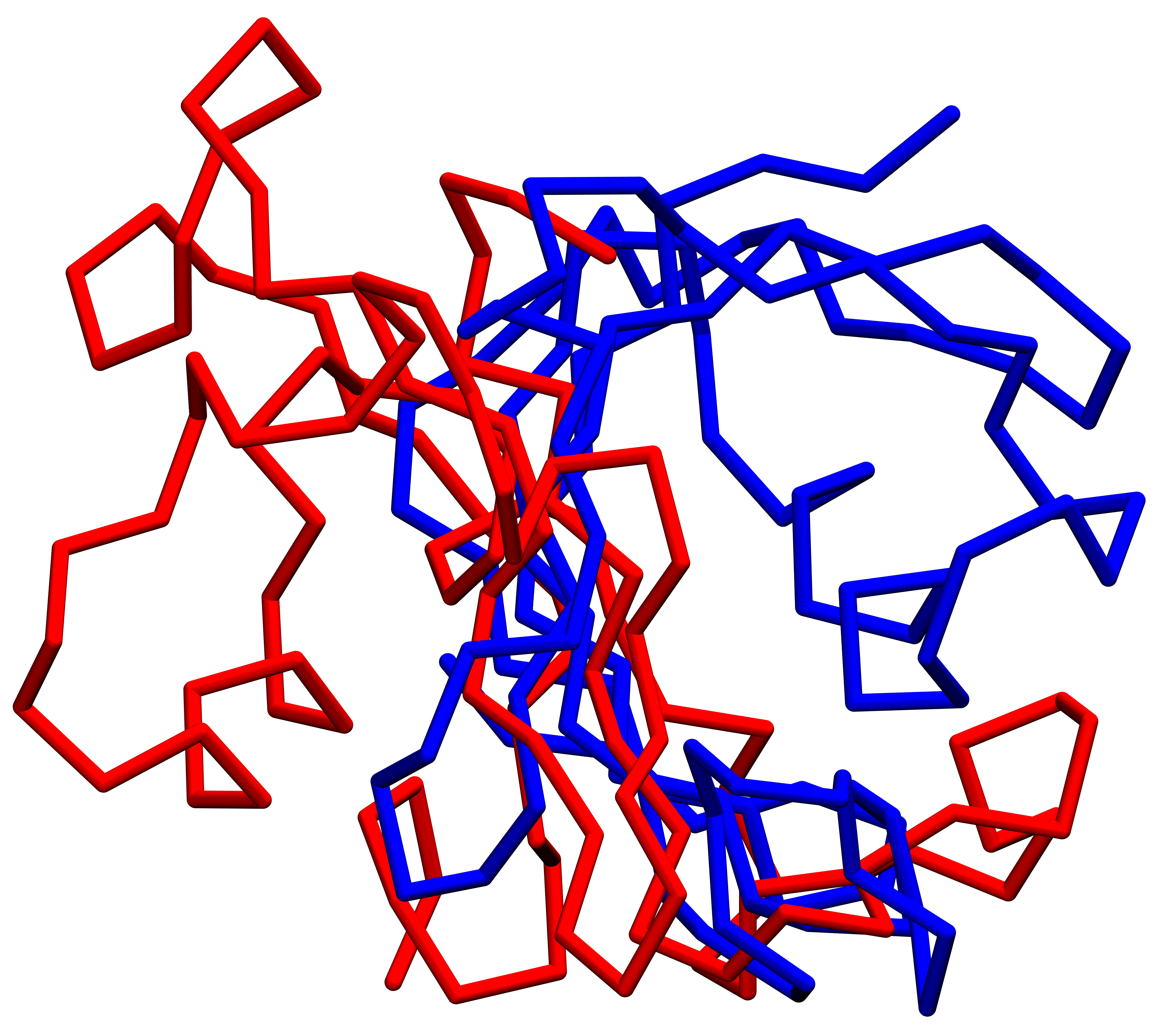
Native vs. a mirror-image fold. Blue: the native Cα reference. Red: the
final conformation of a coarse-grained folding trajectory (the bundled
test_case), superimposed on the native by a proper-rotation (no-reflection)
fit. The two share the same chain topology and nearly the same set of
contacts, yet pack with opposite handedness — the red fold cannot be
rotated onto the blue one, only reflected onto it.
The mirror metrics turn that visual impression into numbers. For this frame:
Metric |
Value |
Reading |
|---|---|---|
\(Q\) |
|
Folded (\(> 0.5\)) — the SS-core native contacts (default |
\(K\) |
|
Every local turn is inverted (\(\ll 0.3\)) — the handedness is completely opposite to native. |
\(\mathrm{RMSD}_\mathrm{native}\) |
|
Proper-rotation fit to the native reference. |
\(\mathrm{RMSD}_\mathrm{reflected}\) |
|
Fit to the reflected native — tighter than to the native itself. |
|
|
\(< 0.9\): the reflected reference fits clearly better. |
|
|
All three conditions met. |
This is exactly the failure mode the analysis guards against: judged by Q
(0.68) the conformation looks like a folded protein, but \(K = 0\) and
RMSD_ratio = 0.77 show it is a mirror image — folded by contacts, wrong by
handedness. Counting it as a genuine (mis)fold would misstate the outcome of the
run.
Per-trajectory verdict
is_mirror is emitted per frame. The tool also prints a single
per-trajectory verdict, TRAJECTORY_MIRROR, taken over the last
--summary-last-frames frames (default 133):
i.e. the tail means of each signal thresholded by the same cutoffs.
Note
The window is deliberately taken over a trailing block of frames, not the whole trajectory: the early trajectory is typically unfolded, and judging a chain’s handedness while it is still a coil would wrongly dilute the verdict. Only once the chain has committed to a fold does the mirror question make sense.
The window is specified in frames, not nanoseconds, on purpose — the time
step written into a CG .dcd is often a placeholder and should not be
trusted. Choose the window from the number of saved frames you consider
“converged”.
Command-line use
python -m topo.analysis.mirror \
    -r reference.pdb \        # all-atom reference (native Cα + STRIDE source)
    -f traj/traj.dcd \        # CG trajectory to score
    -o mirror.csv \           # combined output CSV
    [-p traj/traj.psf] \      # CG topology (optional; see below)
    [-s stride.dat | --segments seg.txt] \   # SS source (optional)
    [--summary-last-frames 133]
Arguments:
Flag |
Type (default) |
Meaning |
|---|---|---|
|
str (required) |
All-atom reference: native Cα geometry, native contacts (Q), and the STRIDE source. |
|
str (required) |
CG trajectory to score. |
|
str (required) |
Output CSV path (parent dirs created if needed). |
|
str (optional) |
CG topology. If omitted, a Cα-only topology is derived from the reference PDB and the DCD attached to it — handy when the PSF flavor differs from the reference. |
|
str (optional) |
Precomputed STRIDE output ( |
|
str (optional) |
Explicit |
|
x/y/z ( |
Axis negated to build the reflected reference (any axis works). |
|
int ( |
Minimum SS element length (residues) kept for chirality. |
|
int ( |
First frame (inclusive; negative indexing supported). |
|
int ( |
Last frame (exclusive; |
|
— ( |
Native-contact definition for Q (identical to Native-contact analysis (the Q score)). |
|
bool ( |
Restrict Q to native contacts whose both residues lie in a secondary-structure element (the same helices/strands used for K). This is the default; pass |
|
float ( |
Classifier thresholds for |
|
int ( |
Trailing frames over which the per-trajectory verdict is taken. |
Important
By default Q here is restricted to secondary-structure elements: only
native contacts whose both residues lie in a STRIDE helix/strand (the same
elements that define K) are counted. This focuses Q on the folded SS core —
exactly the part of the chain whose handedness the mirror question is about — and
makes the is_mirror gate report on the packed scaffold rather than on
flexible loops. Pass --q-ss-only False to recover the whole-molecule
definition (every heavy-atom contact with \(|i-j| >\) local-separation),
as in Native-contact analysis (the Q score). The two definitions give different absolute Q
values; the chirality K and the RMSD ratio are unaffected either way.
Output CSV
One row per scored frame:
Frame,Q,K,RMSD_native,RMSD_reflected,RMSD_ratio,is_mirror
0,0.120,0.364,22.287,22.582,1.013,False
...
26665,0.694,0.091,11.98,5.34,0.446,True
Frame— 0-based frame index (respects--start-frame).Q— fraction of native contacts (secondary-structure elements only by default; whole protein with--q-ss-only False).K— chirality fraction-agreement (\(\to 1\) native-handed, \(\to 0\) mirror).RMSD_native/RMSD_reflected— Å, proper-rotation fit to the native / reflected reference.RMSD_ratio—RMSD_reflected / RMSD_native(lower = more mirror-like).is_mirror— per-frame boolean from the combined rule above.
The console also prints the whole-run mirror-frame fraction and the trailing-window verdict.
Python API
The metrics are importable for custom analysis:
import numpy as np
from topo.analysis import (
    mirror_rmsd, local_chirality, chirality_agreement,
    segment_endpoints_from_stride, classify_mirror,
)
from topo.analysis.mirror import build_cg_universe
from topo.utils.external import run_stride
from topo.analysis import reference_residue_geometry
from topo.analysis.native_contacts import load_universe
from topo.utils.nonbonded import get_residue_mapping

# Native Cα + SS endpoints from the reference
u_ref = load_universe("reference.pdb")
ca_native, _ = reference_residue_geometry(u_ref)
key_to_index, _, _ = get_residue_mapping(u_ref)
endpoints = segment_endpoints_from_stride(run_stride("reference.pdb"), key_to_index)
chi_ref = local_chirality(ca_native[endpoints])

# Score a CG trajectory
u_cg = build_cg_universe("reference.pdb", "traj/traj.dcd")   # psf optional
for ts in u_cg.trajectory:
    pos = u_cg.atoms.positions
    rn, rr = mirror_rmsd(pos, ca_native)
    K = chirality_agreement(local_chirality(pos[endpoints]), chi_ref)[0]
    # ... collect rn, rr, K, Q, then classify_mirror(Q, K, rn, rr)
Key functions: kabsch_proper() (det = +1 fit),
mirror_rmsd(),
local_chirality(),
chirality_agreement(),
segment_endpoints_from_stride(),
classify_mirror().
Typical workflow
Run a folding simulation and score its native-contact Q (Native-contact analysis (the Q score)). If Q climbs toward 1 the run “looks folded”.
Check handedness before trusting that:
python -m topo.analysis.mirror -r reference.pdb -f traj/traj.dcd -o mirror.csv
Interpret. A genuinely native run has \(K \to 1\) and \(\mathrm{RMSD}_\mathrm{native} < \mathrm{RMSD}_\mathrm{reflected}\) (
is_mirror = False). A mirror run has high Q but \(K \to 0\),RMSD_ratio < 0.9, andTRAJECTORY_MIRROR = True— folded by contacts, wrong by handedness.Use the verdict to clean your statistics. When estimating a folded/misfolded fraction over an ensemble, exclude or separately account for mirror trajectories so that (a) mirror artifacts are not counted as native successes, and (b) otherwise-correct folds are not counted as gross misfolds by a reflection-allowing RMSD.