Start here: a refolding simulation from a structure to Q curves
This page takes one globular protein from an all-atom structure to curves of the fraction of native contacts, Q, against time after a temperature quench. It puts four tutorials in the order you need them and adds the checks to make between stages. Each stage links to the tutorial that explains it in detail.
The page covers single-chain globular proteins. A chain with disordered regions
needs the disordered: section of domain.yaml
(Tutorial A.7).
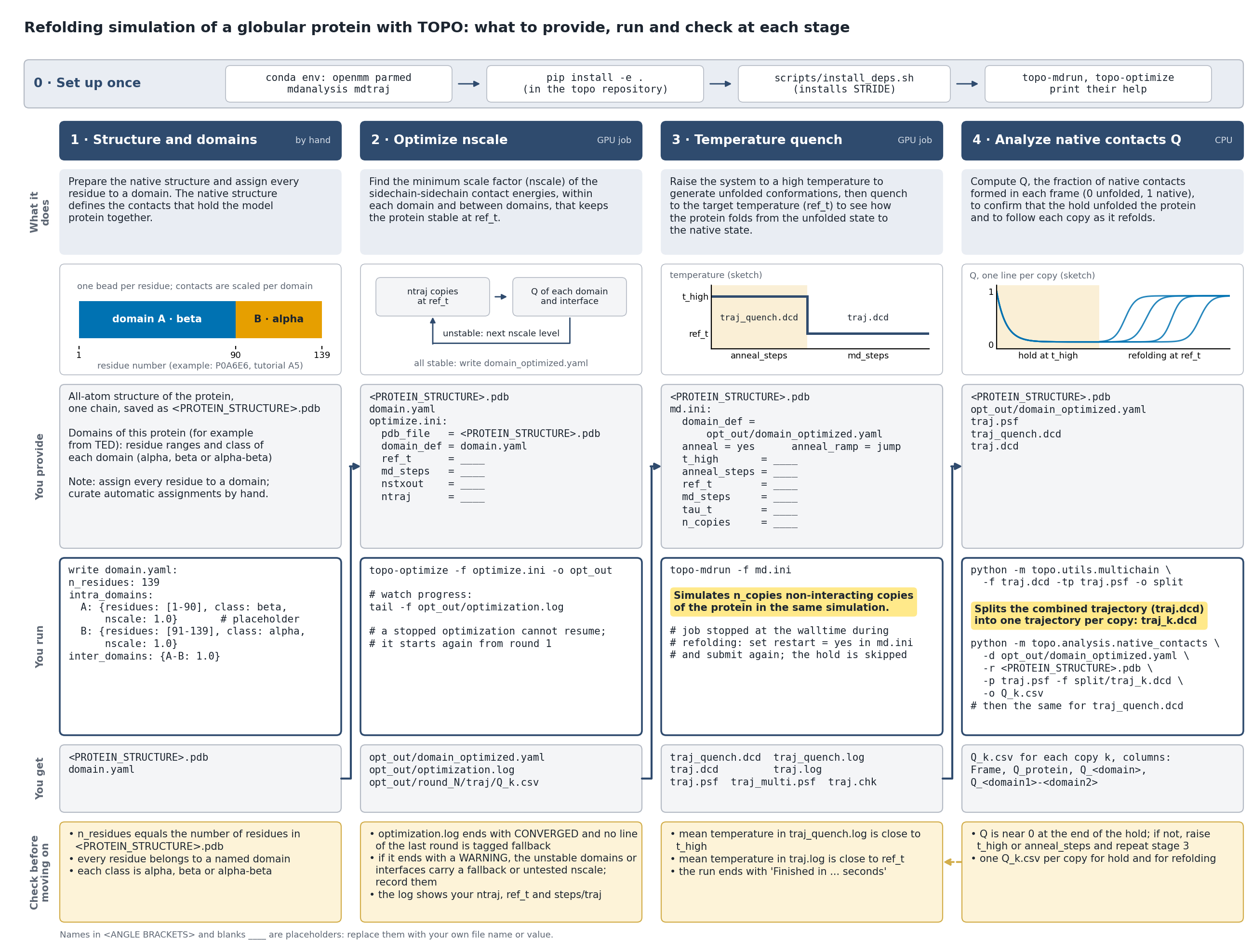
The temperature and Q panels in the figure are sketches, not simulation data.
<PROTEIN_STRUCTURE> stands for the name of your structure file without .pdb.
Replace it, together with the angle brackets, in every command and control file.
Values that depend on your protein are written as ____. They are listed in
Values to choose.
Stage |
What you do |
Command |
Detail |
|---|---|---|---|
0 |
Install TOPO and STRIDE |
|
|
1 |
Prepare the structure and assign domains |
by hand |
|
2 |
Find the |
|
|
3 |
Unfold at high temperature, then quench |
|
|
4 |
Compute Q for every copy |
|
What the model does
TOPO reads an all-atom PDB file and keeps one bead per residue at the C-alpha
position. The native structure defines which residue pairs attract each other,
and the dynamics are Langevin dynamics run with OpenMM. The side chain contact
energies inside each domain and across each domain interface are multiplied by a
factor called nscale. If nscale is too low, the domain unfolds at the
simulation temperature. If it is too high, the fold is over-stabilized. Stage 2
picks the smallest nscale from a fixed list at which every domain and interface
stays folded. Stage 3 unfolds the protein at a high temperature and drops the
thermostat to the working temperature. Stage 4 measures how the native contacts
come back.
Files you will handle
File |
Written by |
Used in |
|---|---|---|
|
you |
stages 2, 3, 4 |
|
you |
stage 2 |
|
you |
stage 2 |
|
|
stages 3, 4 |
|
|
stage 3 |
|
you |
stage 3 |
|
|
stage 4 |
|
|
your plots |
Stage 0. Set up once
Create an environment, install TOPO in editable mode, and install STRIDE, the external program TOPO calls to assign backbone hydrogen bonds.
mamba create -n topo -c conda-forge python">=3.9" openmm parmed mdanalysis \
    mdtraj numpy pandas pyyaml
mamba activate topo
cd /path/to/topo
pip install -e .
scripts/install_deps.sh          # puts stride in $HOME/.local/bin
Confirm that the commands exist:
topo-mdrun                       # prints help
topo-optimize                    # prints help
python -c "import topo, openmm; print('OK', openmm.__version__)"
which stride
If which stride finds nothing, add $HOME/.local/bin to PATH or set
TOPO_STRIDE to the full path of the binary. TOPO looks for STRIDE in
$TOPO_STRIDE, then on PATH, then in topo/bin/
(External dependencies).
The control files on this page set device = GPU, which selects the OpenMM CUDA
platform. Set device = CPU to run without a CUDA GPU.
Before your own protein, run tutorials A.1, A.4, A.5 and A.6 in that order. Each finishes in seconds to minutes with its demo settings.
Stage 1. Structure and domains
Make one working folder per protein and put the all-atom structure in it as
<PROTEIN_STRUCTURE>.pdb. The file must contain one chain. Count the residues:
grep -c '^ATOM.* CA ' <PROTEIN_STRUCTURE>.pdb
Assign every residue to a domain and give each domain a class. TOPO accepts three
class names: alpha, beta and alpha-beta.
One source of domain boundaries for AlphaFold Database models is TED, The
Encyclopedia of Domains (https://ted.cathdb.info; Lau et al., Science 2024,
doi:10.1126/science.adq4946). Search TED with the UniProt accession of your
model. For each domain TED gives a chopping string with the residue ranges. A
domain made of several segments is written with underscores, so a chopping of the
form 11-41_290-389 becomes residues: [11-41, 290-389] in domain.yaml. TED
also gives a cath_label when it can assign one. The first number of a CATH
label is the class: 1 is alpha, 2 is beta, and 3 is alpha-beta.
[AUTHOR: rule for a domain with no CATH label or with CATH class 4.]
TED can leave residues outside every domain, for example linkers and chain ends.
Assign those residues by hand, so that every residue from 1 to n_residues
belongs to a named domain. [AUTHOR: rule for choosing the domain of a residue
that TED leaves unassigned.]
This domain.yaml is the two-domain protein of Tutorial A.5:
n_residues: 139
intra_domains:
  A:
    residues: [1-90]
    class: beta
    nscale: 1.0        # placeholder, the optimizer replaces it
  B:
    residues: [91-139]
    class: alpha
    nscale: 1.0        # placeholder
inter_domains:
  A-B: 1.0             # placeholder
For a single-domain protein, write one domain that covers residues 1 to N and
leave out inter_domains.
Mistakes that stop the run with an error:
n_residuesdiffers from the residue count of the PDB file.A domain has no
class. The optimizer needs it for every domain.A domain has no
nscale.topo-mdrunneeds a number, even as a placeholder.A domain name contains a hyphen. The hyphen separates the two names in an
inter_domainskey.
Mistakes that give no error:
A residue in no domain is placed in an automatic domain
Xwithnscale1.0. The optimizer never adjustsX, and a domain of your own must not be namedX.A residue listed in two domains is assigned to the one written later in the file.
A misspelled
inter_domainskey in a file you write by hand is ignored, and that interface stays at 1.0. The optimizer writes all interface keys itself, so this applies only to files you edit after stage 2.Residue numbers are positions in the chain, counted from 1 in the order of the PDB file. They are not the residue numbers printed in the PDB file if those do not start at 1.
Check that the file parses:
python -c "import yaml; print(yaml.safe_load(open('domain.yaml')))"
Stage 2. Optimize nscale
Write optimize.ini:
pdb_file   = <PROTEIN_STRUCTURE>.pdb
domain_def = domain.yaml
ref_t      = ____      ; K, temperature of the stability test
md_steps   = ____      ; steps per trajectory
nstxout    = ____      ; steps between saved frames; these frames are scored
nstlog     = ____
ntraj      = ____      ; independent trajectories per round
device     = GPU
Run it:
topo-optimize -f optimize.ini -o opt_out
In each round the optimizer runs ntraj independent copies of the protein at
ref_t in one simulation and computes Q for every domain and interface in every
saved frame. A domain or interface is stable if, in every trajectory, Q is above
q_threshold in at least frame_fraction of the frames. Each unstable domain or
interface moves up one level in the nscale list of its class, and the next
round starts. Tutorial A.5 gives the levels, and
Optimizer control options gives every key
and its default.
A domain or interface that is still unstable at level 5 is set to the fallback
value, which is level 3 of its class, and this value is tested in one more round.
The optimizer stops when everything is stable, when every unstable domain or
interface is already at the fallback value, or after max_rounds rounds.
domain_optimized.yaml is written in all three cases, so its presence does not
show that the optimization succeeded.
Outputs in opt_out/:
domain_optimized.yaml: the same domains with the selectednscalevalues.optimization.log: the native contact count of each domain and interface, then for each round thenscalevalues tested and the folded fraction of each trajectory.<PROTEIN_STRUCTURE>_stride.dat: the STRIDE output, computed once.round_N/: thedomain.yamlandmd.iniof round N, and inround_N/traj/the trajectories and oneQ_k.csvper copy.
Follow a running optimization with tail -f opt_out/optimization.log.
Checks before stage 3:
The last line of
optimization.logstarts with# CONVERGED.No line in the last
## Roundblock carries the tagfallback. A run can end with# CONVERGEDat the fallback value. That domain or interface was unstable at the same value in an earlier round and at the two levels above it, so record it.If the log ends with a
WARNINGblock, it names the domains or interfaces that are still unstable. Theirnscaleindomain_optimized.yamlis the fallback value, or, ifmax_roundswas reached first, one level above the last level tested. That value was never simulated.The header line (
# ntraj=... T=... K Q>... for >=...% of frames) shows yourntrajandref_t, and the linerunning N-copy MD (... steps/traj)in each round shows yourmd_steps. A misspelled key inoptimize.inigives no error, and the default is used.
Three properties of the optimizer to plan for:
If
md_stepsis missing, the default is 10,000 steps (150 ps at the 15 fs time step). That length cannot distinguish a folded domain from an unfolded one.n_copies,output_dirandoutnameinoptimize.iniare ignored. The optimizer sets them itself.A stopped optimization cannot be resumed. A new call starts again from round 1, so a job time limit must cover all rounds.
Stage 3. Temperature quench
Write md.ini:
pdb_file   = <PROTEIN_STRUCTURE>.pdb
model      = topo
domain_def = opt_out/domain_optimized.yaml
stride_output_file = opt_out/<PROTEIN_STRUCTURE>_stride.dat

dt     = 0.015         ; ps
tcoupl = yes
ref_t  = ____          ; K, refolding temperature
tau_t  = ____          ; ps^-1, Langevin friction

anneal       = yes
anneal_ramp  = jump    ; thermostat drops from t_high to ref_t in one step
t_high       = ____    ; K, unfolding temperature
anneal_steps = ____    ; steps held at t_high
md_steps     = ____    ; steps at ref_t after the jump

n_copies   = ____      ; independent copies of the chain in this run
copy_shift = 5.0       ; nm, starting offset between copies

pcoupl = no
pbc    = no
output_dir = quench_run1
outname    = traj
nstxout = ____
nstlog  = ____
restart  = no
minimize = no
device   = GPU
stride_output_file reuses the STRIDE output of stage 2. Without this key,
topo-mdrun runs STRIDE again at every start and writes
<PROTEIN_STRUCTURE>_stride.dat in the directory it was started from.
Run it:
topo-mdrun -f md.ini
The run has two phases, and each writes its own files in output_dir. The hold
at t_high lasts anneal_steps steps and writes traj_quench.dcd and
traj_quench.log. The refolding phase at ref_t lasts md_steps steps and
writes traj.dcd and traj.log, with the step counter starting again from 0.
The copies do not interact, so one run with n_copies copies gives n_copies
independent refolding trajectories. Other files in the folder are traj.psf
(topology of one chain), traj_multi.psf (topology of all copies), traj.chk
(checkpoint of the refolding phase), traj_final.pdb and
<PROTEIN_STRUCTURE>_CA.pdb (the native structure at one bead per residue).
After a change of the thermostat temperature the chain needs a time of about
1/tau_t to follow it. The hold must last many times 1/tau_t, and long enough
for the chain to lose its native contacts. Tutorial A.6 uses tau_t = 1.0 so
that its demo finishes in seconds. Do not copy its tau_t and anneal_steps.
Checks:
The standard output ends with
--- Finished in ... seconds ---.The mean temperature in each log is close to the set value. Single frames of a small chain fluctuate, so compare the mean.
import numpy as np
from topo.reporter.topo_reporter import readOpenMMReporterFile
for f in ["quench_run1/traj_quench.log", "quench_run1/traj.log"]:
    d = readOpenMMReporterFile(f)
    print(f, round(np.array(d["Temperature (K)"]).mean()), "K")
Practical points:
Every fresh run overwrites the files in its
output_dir. Give each run its own folder name.If the run stops during the refolding phase, set
restart = yes, keepoutput_dir,outnameand all protocol keys unchanged, and start it again. The run skips the hold and continues fromtraj.chk.md_stepsstays the total length of the refolding phase. If the run stops during the hold, no checkpoint exists and the restart begins again with the hold.Leave
nstcommunset whenn_copiesis larger than 1.
Stage 4. Analyze the fraction of native contacts Q
Q is the fraction of native contacts that are formed in a frame, from 0
(unfolded) to 1 (native). The native contacts are taken from the all-atom
<PROTEIN_STRUCTURE>.pdb: two residues more than 3 apart in sequence with any
pair of heavy atoms within 4.5 Angstrom. A contact counts as formed in a frame
when the C-alpha distance is at most 1.2 times its native value. The number of
contacts in this list differs from the native contacts number TOPO prints when
it builds the model, because the model uses its own contact definition for the
energies.
A run with n_copies larger than 1 writes one combined trajectory, in which
every frame holds all copies of the chain. The Q scorer accepts only a trajectory
with one bead per residue of the reference structure, so split both combined
trajectories into one file per copy, then score each file:
mkdir -p split Q
python -m topo.utils.multichain -f quench_run1/traj.dcd \
    -tp quench_run1/traj.psf -o split --outname traj
python -m topo.utils.multichain -f quench_run1/traj_quench.dcd \
    -tp quench_run1/traj.psf -o split --outname traj_quench

for f in split/*.dcd; do
  k=$(basename "$f" .dcd)
  python -m topo.analysis.native_contacts -d opt_out/domain_optimized.yaml \
      -r <PROTEIN_STRUCTURE>.pdb -p quench_run1/traj.psf -f "$f" -o "Q/Q_${k}.csv"
done
This writes Q/Q_traj_quench_k.csv (hold) and Q/Q_traj_k.csv (refolding) for
each copy k. Each file has one row per frame and the columns Frame, Q_protein
(all native contacts), one Q_<domain> per domain, and one
Q_<domain1>-<domain2> per interface.
Check the hold first, then plot the refolding curves:
import glob
import pandas as pd
import matplotlib
matplotlib.use("Agg")
import matplotlib.pyplot as plt

dt = 0.015        # ps, from md.ini
nstxout = ____    # steps between saved frames, from md.ini

for f in sorted(glob.glob("Q/Q_traj_quench_*.csv")):
    q = pd.read_csv(f)
    print(f, "mean Q over last 10 frames of the hold:",
          round(q["Q_protein"].tail(10).mean(), 3))

fig, ax = plt.subplots()
for f in sorted(glob.glob("Q/Q_traj_[0-9]*.csv")):
    q = pd.read_csv(f)
    ax.plot((q["Frame"] + 1) * nstxout * dt / 1000, q["Q_protein"], lw=0.8)
ax.set_xlabel("time at ref_t (ns)")
ax.set_ylabel("Q, whole protein")
ax.set_ylim(0, 1)
fig.savefig("Q_refolding.png", dpi=200)
Checks:
Q is near 0 at the end of the hold in every copy. If the chain kept part of its native structure, the refolding curves are biased by it. Raise
t_highoranneal_stepsand repeat stage 3. [AUTHOR: the Q value you accept at the end of the hold; the lab guide uses 0.2.]There is one refolding file and one hold file per copy.
Running on a cluster
Stages 2 and 3 are the expensive ones and usually run as batch jobs on a GPU node. A Slurm job script has this shape. The account, partition and GPU request depend on your site.
#!/bin/bash
#SBATCH --job-name=____
#SBATCH --account=____
#SBATCH --partition=____
#SBATCH --gpus=1
#SBATCH --time=____

# activate the environment explicitly; a batch job does not always
# inherit the environment of your login shell
conda activate topo
cd $SLURM_SUBMIT_DIR
topo-optimize -f optimize.ini -o opt_out      # stage 2
# topo-mdrun -f md.ini                        # stage 3
Two points apply to any scheduler. The stage 2 job must be able to find STRIDE,
so PATH or TOPO_STRIDE must be set inside the job. The time limit of the
stage 2 job must cover all rounds, because the optimizer cannot resume.
Values to choose
Key |
File |
Meaning |
|---|---|---|
|
|
temperature of the stability test (K) |
|
|
steps per stability trajectory |
|
|
steps between scored frames |
|
|
trajectories per round |
|
|
refolding temperature (K) |
|
|
Langevin friction (ps^-1) |
|
|
unfolding temperature (K) |
|
|
steps held at |
|
|
steps at |
|
|
refolding trajectories per run |
|
|
steps between saved frames |
What this page was checked against
The commands, keys, file names and defaults on this page were checked against the TOPO source at commit fc03be2 (2026-09-07). If a command or key fails with a later version, compare it with the README of the matching tutorial.