Tutorial 5 — Optimizing the contact nscale (nscale)
Goal: instead of hard-coding the per-domain and per-interface contact
nscales in domain.yaml (as in Tutorial 2),
this tutorial searches for them automatically, so the force field is just
strong enough to keep the native structure of every domain and interface folded.
The one thing to remember: the quantity being optimized is the
nscalefield indomain.yaml(nscale in the literature). The optimizer chooses those values for you —intra_domains[...].nscalefor each domain andinter_domainsfor each interface.
Time: minutes on a GPU (10 copies × short MD × up to 6 rounds); longer for a production-length protocol.
Prerequisites: Tutorial 2
(what nscale does) and Tutorial 4
(the multi-copy runs the optimizer uses to collect independent trajectories).
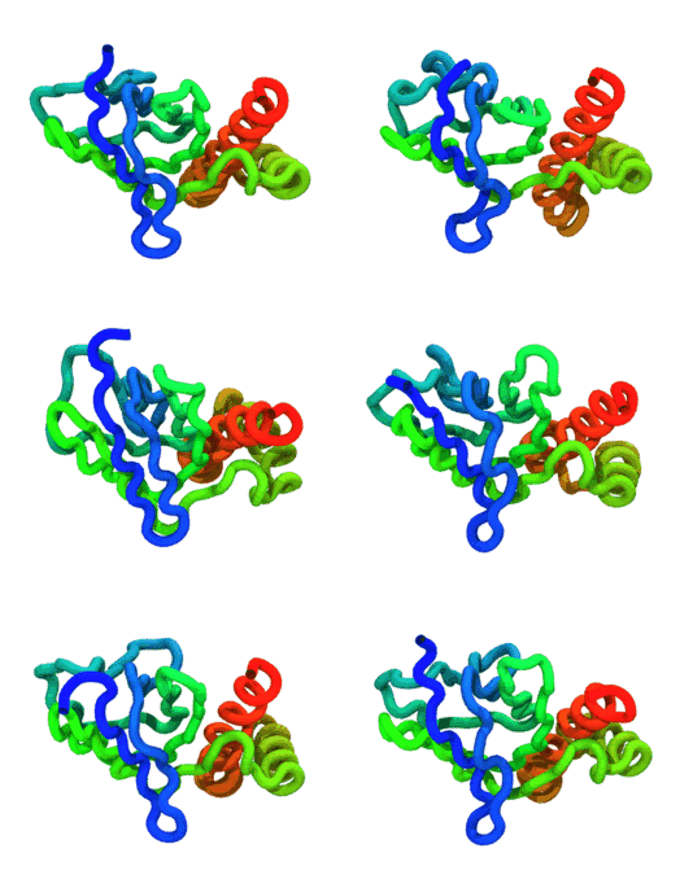
One stability trajectory — each round runs 10 of these; the fraction that stay folded (via Q) decides whether the current nscale passes or is raised.
Regenerate from any round’s output, e.g.
python ../_viz/render_cg.py --psf opt_out/round_1/traj/traj.psf --dcd opt_out/round_1/traj/traj_0.dcd --out img --hero 0 --stride 10.
Files in this folder
File |
Role |
|---|---|
|
All-atom reference structure (139 residues, two domains). |
|
Initial domains: residue ranges + structural |
|
Minimal config for the optimizer (the new ingredient). |
|
Thin shim to |
|
Thin shim to |
|
Legacy CHARMM/SLURM reference implementation — not used; kept for provenance. |
1. The problem
A single contact nscale rarely fits a whole protein. Too low and a domain unfolds during the simulation; too high and you over-stabilize the fold and wash out the dynamics you want to study. A multidomain protein needs a separate nscale for every domain and every domain–domain interface — tedious and not reproducible to choose by hand. The optimizer searches for the smallest nscale, drawn from a small discrete ladder, at which each domain and interface stays folded across many independent trajectories.
2. Basic theory
The native contact interactions are divided into groups by the domains (e.g. from the CATH database). Each domain starts at the level-1 nscale for its structural class (α, β, α/β, or interface; Table 1).
Then ntraj independent MD trajectories at 310 K are run for the current CG
model, and the Q value (fraction of native contacts formed) of every domain and
interface is monitored. A domain/interface is stable when all ntraj
trajectories keep its Q above the threshold Q = 0.6688 for ≥ 98 % of the
frames.
Any unit that fails has its nscale raised to the next level, while the
already-stable ones keep their current value; a new model is generated and the
test repeated until everything is stable. If a unit still cannot be stabilized at
the highest level, the median nscale of its class (level 3) is used for the
final model regardless of stability.
Table 1. nscale (nscale) levels per structural class.
Structural Class |
Level 1 |
Level 2 |
Level 3 |
Level 4 |
Level 5 |
|---|---|---|---|---|---|
α |
1.1954 |
1.4704 |
1.7453 |
2.0322 |
2.5044 |
β |
1.4732 |
1.8120 |
2.1508 |
2.5044 |
2.5044 |
α/β |
1.1556 |
1.4213 |
1.6871 |
1.9644 |
2.5044 |
Interface |
1.2747 |
1.5679 |
1.8611 |
2.1670 |
2.5044 |
Calibrated on a training set of 18 small single-domain proteins.
3. The search algorithm (per round)
Each round is one set of nscales tested. For each round the optimizer:
Writes
round_N/domain.yamlwith the current nscales.Runs one multi-copy MD (
topo.mdrunwithn_copies = ntraj) →ntrajindependent chains in a single run, and splits the combined trajectory into per-copy DCDs (topo.split_chains).Scores Q per frame for every domain and interface (
topo.analysis.native_contacts).Decides per unit: a unit is stable if all
ntrajtrajectories are folded (Q > 0.6688) for ≥ 98 % of frames.All units stable → done.
Otherwise each unstable unit climbs one ladder level (stable units stay frozen) and the next round runs.
Because every unstable unit climbs independently, different domains converge
at different levels. After level 5, a still-unstable unit drops to the median
(level-3) fallback. max_rounds defaults to 6 (5 levels + fallback); a
protein still unstable after that is flagged with a WARNING in the report so
you can inspect or exclude it.
4. Run it
topo-optimize -f optimize.ini -o opt_out
That’s the whole command (the installed console script). Equivalent forms:
python -m topo.optimize -f optimize.ini -o opt_out, or the in-folder shim
python optimization.py -f optimize.ini -o opt_out. Watch progress live with tail -f opt_out/optimization.log
(it marks each round’s MD/scoring phase) and opt_out/round_N/traj/traj.log (the
live MD step counter).
Testing overrides:
--device CPUand--md-steps Noverrideoptimize.inifor a quick local run.
5. The optimize.ini config
optimize.ini is deliberately minimal — only the essentials, in a single
[OPTIONS] section. The optimizer takes the keys it needs (ntraj,
q_threshold, frame_fraction, max_rounds, min_contacts); every other key is
a simulation parameter passed through to each round’s md.ini. Everything else
(timestep, thermostat, model, device, output naming, …) comes from the
optimizer’s built-in protocol defaults, so you don’t repeat a full md.ini.
[OPTIONS]
# inputs + simulation parameters (passed through to each round's md.ini)
pdb_file   = P0A6E6.pdb        ; all-atom reference (native contacts + geometry)
domain_def = domain.yaml       ; initial domains + class; nscales get optimized
md_steps   = 100000            ; steps per trajectory
nstxout    = 100               ; trajectory output frequency (frames feed Q)
nstlog     = 100
ref_t      = 310               ; K

# optimizer controls (consumed by optimization.py)
ntraj          = 10            ; independent trajectories per round (= n_copies)
q_threshold    = 0.6688        ; a frame is "folded" for a unit if Q > this
frame_fraction = 0.98          ; a trajectory is "stable" if >= this fraction folded
max_rounds     = 6             ; 5 ladder levels + median fallback
min_contacts   = 0             ; units with fewer native contacts than this are
                               ;   pinned at level 1 and not optimized (0 = off)
A domain or interface with fewer than min_contacts native contacts is treated as
too weakly structured to fold: it is pinned at the first ladder level and excluded
from optimization (it never climbs and never blocks convergence). This is useful
for interfaces between domains that barely touch, or small/disordered domains that
would otherwise spuriously read as “unstable” and waste rounds. The default 0
disables the check.
Each round the optimizer expands this into a full round_N/md.ini (one implicit
default worth knowing: dt = 0.015 ps, the model’s 15 fs timestep — not the
package’s bare 0.01 default).
6. The domain.yaml — note the class field
Same format as Tutorial 2, plus a class per domain (the only field the
optimizer needs beyond residues):
n_residues: 139
intra_domains:
  A:
    residues: [1-90]
    class: beta            # alpha | beta | alpha-beta  (selects the ladder)
    nscale: 1.1556       # placeholder — overwritten each round
  B:
    residues: [91-139]
    class: alpha
    nscale: 1.6871
inter_domains:
  A-B: 1.8611              # placeholder too
class picks which Table-1 ladder a domain climbs; interfaces always use the
Interface ladder. (class is ignored by topo.mdrun/run_simulation.py, so
the same file works for production runs.) For the full field reference —
including the accepted class values and the domain-naming rules — see
Domain definition file.
7. What it produces
Under the -o directory:
Path |
Contents |
|---|---|
|
The report: native-contact counts, and per round the chosen nscales + per-unit stability, ending in the final nscales (or a WARNING). |
|
The exact inputs used that round. |
|
The MD outputs ( |
|
The calibrated model — the result. |
8. Under the hood (reusable package pieces)
topo.analysis.native_contacts— the Q scorer. Native contacts are defined from the all-atom reference (heavy-atom ≤ 4.5 Å, sequence separation3); a contact is formed in a CG frame when dCG ≤ 1.2 × dnative. It emits one Q column per domain and per interface. Use it standalone too:
python -m topo.analysis.native_contacts -d domain.yaml -r ref.pdb \
    -p traj/traj.psf -f traj/traj.dcd -o Q.csv
topo.split_chains— splits a combined multi-copy DCD into per-copy DCDs via memory-bounded streaming (handles trajectories too large for RAM). CLI:python -m topo.utils.multichain -f combined.dcd -n N -o out/.
9. Use the result
domain_optimized.yaml is a ready-to-use domain.yaml — point a production run
straight at it (the extra class field is harmless):
# md.ini
domain_def = domain_optimized.yaml
topo-mdrun -f md.ini
Try next
Tighten/loosen the criterion (
q_threshold,frame_fraction) and watch the converged levels shift.Increase
md_stepstoward the published ~0.5 µs protocol for production calibration (the demo value is short).
Status: the optimizer is a package module (
topo.optimize, exposed as thetopo-optimizeconsole command); the Q scorer and trajectory splitting are stable package functions. The one remaining limitation is optimization-level restart/resume (each invocation starts fresh).