Tutorial 7 — Protein synthesis through an analytic exit tunnel
This is the structure-based (topo) twin of cosmo’s tutorial 09. The
ribosome-based runner (Tutorial 8)
builds the ribosome from explicit beads and threads the nascent chain through
the coarse-grained exit tunnel. Here the tunnel is modelled
analytically instead: a cylindrical bore of radius r along the X-axis
drilled through an infinite wall at x_exit (a “hole in an infinite wall”).
There are no ribosome beads — the System is the nascent chain only, so it is
fast and never jams.
The chain is a folded protein built with topo’s structure-based Gō contacts, so it can fold co-translationally as it extrudes and once it clears the bore.
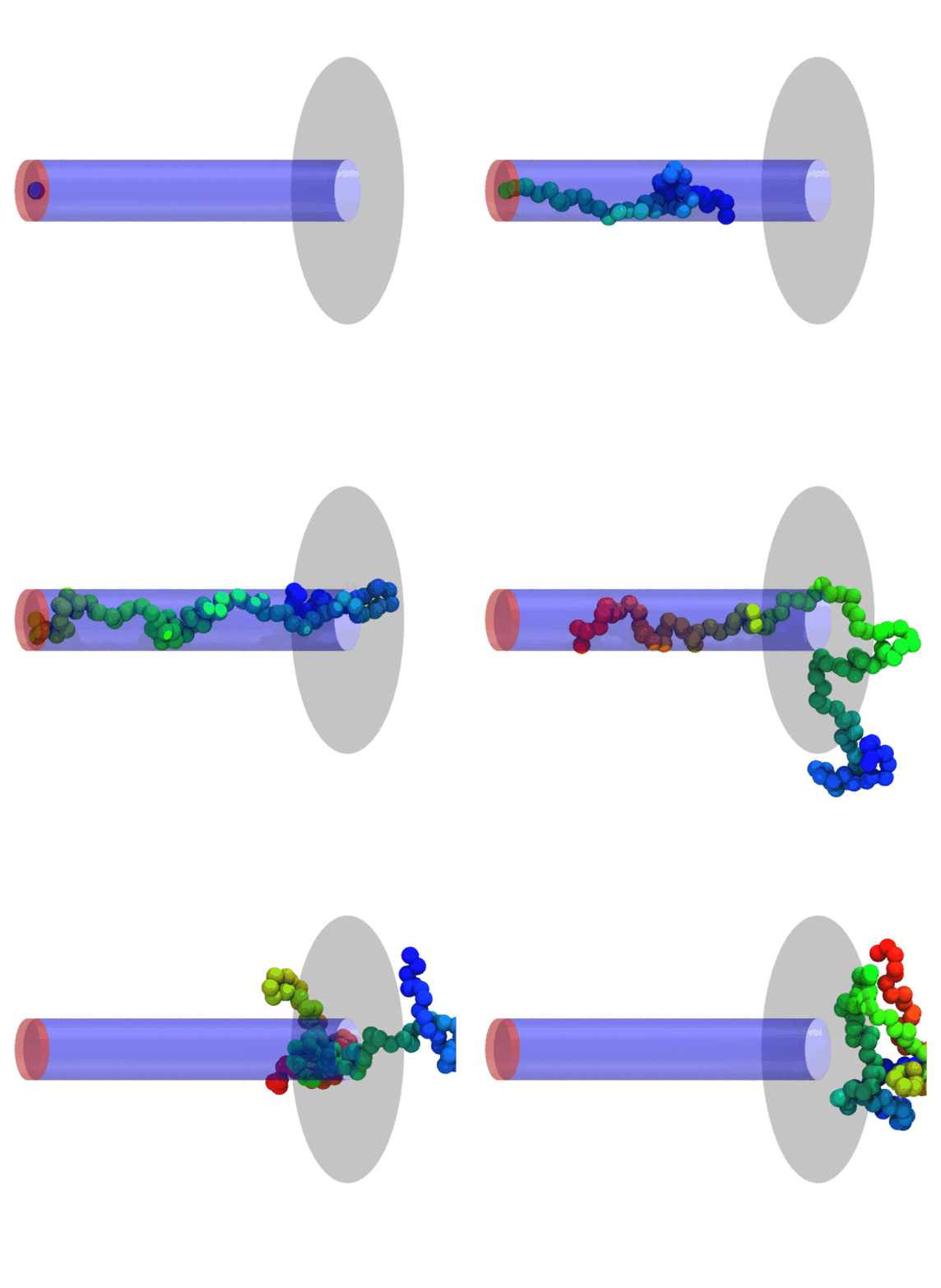
Protein synthesis → ejection. The chain (N→C rainbow beads) grows from the PTC (C-terminus, red) and extrudes N-terminus-first down the transparent blue bore (with the red closed PTC cap and the translucent grey exit-face wall), emerges past the wall, and folds into the ejected protein just outside the tunnel.
The tunnel is a pure force (no beads); the drawn geometry is read from the same
cylinder.ini. Regenerate after a run:python make_movie_cylinder.py -o synth_out -f cylinder.ini # stitch movie + tunnel python ../_viz/cylinder_tunnel_tcl.py -f cylinder.ini -o synth_out/tunnel.tcl # beads (VDW+Licorice) hide sentinel-parked beads cleanly; a zoomed-out view # (scale<1, bigger beads) shows the whole grow→thread→eject path in one frame. python ../_viz/render_cg.py --psf synth_out/movie.psf --dcd synth_out/movie.dcd \ --out img --hero last --no-align --rep beads --bead-radius 2.6 --scale 0.78 \ --select "name CA and x < 9000" --selupdate --extra-tcl synth_out/tunnel.tcl(the shipped GIF trims the trajectory to the end of ejection, before the free protein diffuses off-axis — slice
movie.dcdto the ejection frames first.)
The cylinder ribosome model (topo.csp.cylinder)
The analytic tunnel is a different physics of confinement than the explicit-bead
ribosome, so it lives in the package as a parallel module to the explicit-bead
runner (topo.csp.protocol): topo.csp.cylinder,
driven by the topo-cylinder console command. It reuses the package’s tested,
unchanged low-level machinery from topo.csp.core (the one-time contact precompute,
the build-once-subset length model, the seed / restrain / output path) and adds only
the one new force, add_tunnel_cylinder, plus its own nascent-only synthesis loop.
Timing is the same O’Brien codon kinetics as topo-csp — each residue’s MD length
comes from its codon dwell time (mrna + scale_factor) via topo.csp.kinetics. The
only difference from the explicit protocol is that the cylinder runs a single MD
segment per residue (there is no A→P translocation to split into three sub-stages).
The model (forbidden region S)
   d                              (cytosol: free, any d)
   ^   |##### solid ribosome S #####|
 r |···|············ bore ··········|··············>  allowed past exit
   +---|----------------------------|----------------> x
     x_lo (PTC)                  x_exit
       |##### solid ribosome S #####|
                              ^ infinite exit-face wall (d > r)
A bead is penalised by its penetration depth into S (everything outside the
bore up to the exit face, plus the closed PTC end), escaping via whichever face is
nearer — the bore wall (radial inward push → keeps the chain extended) or the exit
face (+x push → a cytosol bead can re-enter the tunnel only through the bore).
The 90° mouth corner is rounded by a fillet (radius rho) so the potential is
continuous and the MD is stable. The C-terminus is seeded and position-restrained
on the tunnel axis at the PTC (x_lo, 0, 0); new residues are seeded there.
Run
cd tutorials/07_translation_cylinder
topo-cylinder -f cylinder.ini          # or: python -m topo.csp.cylinder -f cylinder.ini
All parameters live in cylinder.ini ([OPTIONS] section). The
nascent chain is the 106-residue P0CX28, with domain.yaml + the precomputed STRIDE
for the contact map, and P0CX28_mrna.txt for the codon kinetics. Tunnel defaults:
bore radius 0.9 nm, length 10.0 nm (x_lo=0, x_exit=10), axis on X, mouth
fillet 0.2 nm, wall stiffness 8368 kJ/mol/nm². The kinetics keys (mrna,
scale_factor, time_stage_1/2, max_steps_per_stage) are the same as the CSP
tutorials; the demo caps each residue at 2000 steps (delete the clamps for production).
Post-synthesis: ejection and dissociation
Once the chain reaches its final length, two optional post-synthesis free runs
continue the same system from the finished structure — the same ejection_steps /
dissociation_steps keys as topo-csp. Both phases release the C-terminus
restraint, so the completed protein is free to diffuse; the analytic tunnel stays on
(bore + closed PTC end + exit wall), so the only way out is +x through the exit. This
tests whether the nascent protein diffuses out of the tunnel and folds in the
cytosol.
ejection(ejection_steps) — the first free run, written to<outdir>/ejection/.dissociation(dissociation_steps) — a continued free run seeded from the ejection structure, written to<outdir>/dissociation/.
ejection_steps     = 300_000   # use a LONG run so the protein can clear the tunnel
dissociation_steps = 0         # 0 -> skip
Visualize / validate
Use the tutorial’s movie tool — it stitches the per-length trajectories (reusing the
shared stitcher in topo.csp.movie) and draws the analytic tunnel (bore
tube, closed PTC cap, and the infinite exit-face wall as an annulus whose hole is the
bore), reading the geometry from the same cylinder.ini:
python make_movie_cylinder.py -o synth_out -f cylinder.ini
vmd -e synth_out/movie.tcl
You then see the chain thread the (blue, transparent) bore, the red PTC end cap it
grows away from, and the grey exit wall it emerges through — then fold once it
clears the tunnel. (Plain topo-csp-movie -o synth_out also works
— it just omits the tunnel.)