Tutorial 8 — Protein synthesis on a coarse-grained ribosome
Goal: synthesize a protein residue by residue on TOPO’s own coarse-grained
ribosome, using codon-resolved kinetics with topo-csp. This is the
ribosome-based counterpart to Tutorial 7,
which replaces the physical ribosome with an analytic cylindrical tunnel.
Unlike the CHARMM-based O’Brien reference, everything here is standalone
TOPO: the ribosome is a truncated CG bead model (ribosome_trunc.pdb, loaded
by topo.csp.ribosome.load_ribosome) — no external .cor/.psf/.prm files.
The nascent chain grows N→C through the exit region and is ejected once
complete.
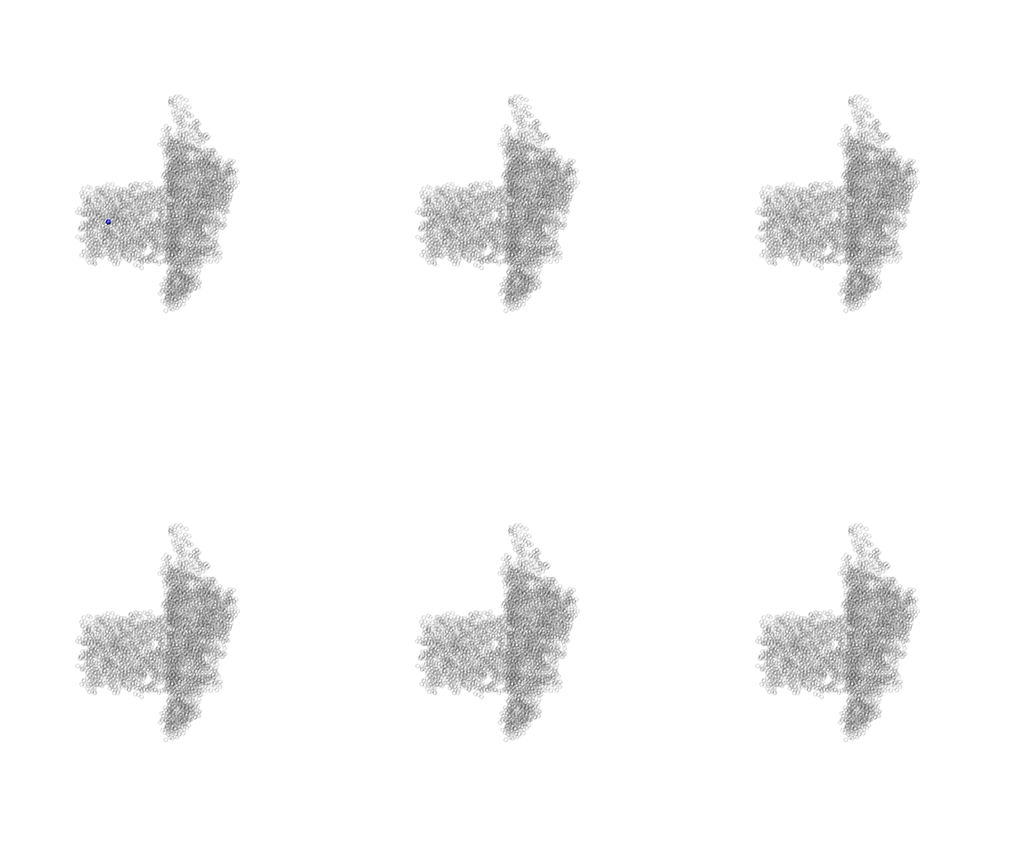
Synthesis on the ribosome — the chain (coloured beads) grows through TOPO’s coarse-grained ribosome (translucent grey); already-emerged N-terminal residues fold while the C-terminus is still being added inside.
The GIF is for the
4c5c/system. After a run, stitch the per-length frames into one movie and render it (beads + the translucent ribosome as context):topo-csp-movie -o synth_out # -> synth_out/movie.{psf,dcd} python ../_viz/ribosome_scenery_tcl.py -p ribosome_trunc.pdb -o synth_out/ribo.tcl python ../_viz/render_cg.py --psf synth_out/movie.psf --dcd synth_out/movie.dcd \ --out img --hero last --no-align --rep beads --fit-main-only \ --select "name CA and x < 9000" --selupdate --extra-tcl synth_out/ribo.tcl(the growing chain parks not-yet-synthesized beads at a far sentinel, which
--select … --selupdatehides.)
Prerequisite: the coarse-grained model of Tutorial 1 and the domain-scaling idea of Tutorial 2.
Two worked systems
System |
Residues |
Notes |
|---|---|---|
|
306, multidomain |
Full-length synthesis |
|
106, single-domain |
The single-domain protein from Tutorial 1, |
Files (per system)
File |
Role |
|---|---|
|
Target folded structure (defines the native contacts). |
|
Precomputed STRIDE backbone hydrogen bonds. |
|
Domain definition / contact |
|
The mRNA codon sequence that times each residue. |
|
Per-codon translation times (kinetics input). |
|
TOPO’s coarse-grained truncated ribosome. |
|
Full-length run config ( |
|
Short clamped debug profile (4c5c only). |
|
Post-run validation report. |
Run it
From a system folder (e.g. 4c5c/):
topo-csp -f csp_val.ini # -> synth_out/
The runner uses codon-resolved kinetics (each elongation cycle split into
three kinetic sub-stages) with a per-stage dt-halving stability guard, rigid
AllBonds (the default), and always-on equilibrium-PTC seeding — each new
residue is placed one peptide bond from the previous C-terminus, clear of the
ribosome, so rigid bonds seed cleanly. A successful full-length run shows no
[stability] lines in the log.
What it produces
synth_out/L_001/ … L_<L_max>/— one folder per chain length, each with the MD trajectory and the nascent structure at that length.synth_out/ejection/— the post-synthesis release:traj_final.pdb, the built-once native-contact PDB, and run metadata.
Validating the run
python analyze_standalone.py
It checks that per-stage potential energy stays finite (no blow-ups) and that
the ejected chain diffuses cleanly out of the tunnel without penetrating the
ribosome. Its quantitative cross-check against the O’Brien reference relies
on the reference run from the retired CSP-development tutorials (12/13/15), which
now live under sandbox/retired_translation_tutorials/; the energy-stability and
ejection checks are self-contained and do not need them.